Share
In June 2019, the UK pledged to reach ‘net zero emissions by 2050’, the first major country to do so. But what does that mean for the UK? And what can we do to help reach this net zero target?
What does net zero mean?
It means cutting greenhouse gas emissions, especially carbon dioxide, to as close to zero as possible.
This involves any action that removes as much carbon in the atmosphere as is put into it. For example, a house with solar panels that sends renewable energy to the grid that is equal to the amount of energy taken out is net zero.
Another term often used to mean net zero is carbon neutral.
Net zero is what the UK is aiming to achieve by 2050. It will involve huge changes to lifestyles and industries to cut all man-made emissions.
What does zero carbon mean?
This term describes an activity where no carbon was produced in the first place.
A house that’s off the grid and is completely powered by renewable energy would be zero carbon. This is because renewable energy such as wind and solar don’t produce carbon, while fossil fuels do.
What about negative emissions?
To achieve negative emissions, more carbon must be removed from the atmosphere then is emitted. This is also known as carbon dioxide removal (CDR).
The UK will need to investigate carbon dioxide removal to remove any remaining greenhouse gasses not directly caused by human activity.
There are a few potential ways to achieve negative emissions. Some of these approaches include:
- Reforestation and planting new forests (afforestation) to remove and store carbon. Over the last few decades, the world’s forests have absorbed approximately 30% of the global man-made CO2 emission.
- Carbon capture and storage (CSS). This is where CO2 is extracted from the atmosphere and stored underground.
- Direct air capture, which sucks CO2 from the air, is the most practical solution in achieving negative emissions.
Negative emission technologies will have a part to play in the goal to reach net zero.
But currently, a lack of money invested in researching and developing these technologies will mean we must do more to reduce greenhouse gasses before we can completely remove them.
What are the UK’s climate targets?
In line with the Paris Climate Agreement to limit the impact of global warming to below 1.5°c, the UK has pledged to reach net zero greenhouse gas emissions by 2050.
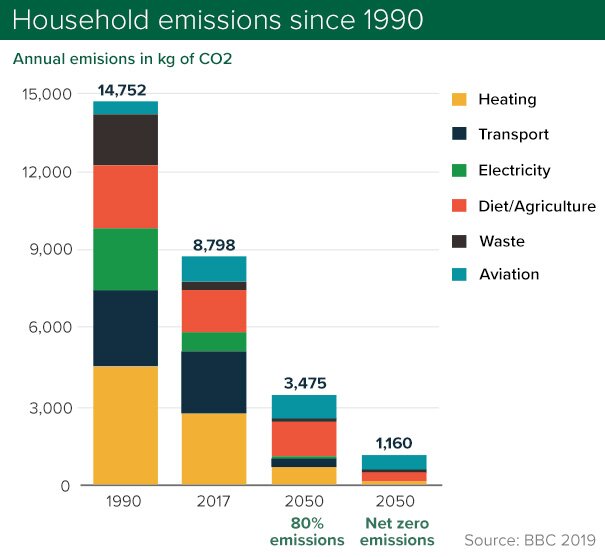
This means a 100% reduction of all greenhouse gas emissions compared to 1990 levels by 2050.
But currently, the UK is not on track to reach its net zero targets unless it takes urgent action to change people’s behaviour and business practices.
How can the UK reach its 2050 target?
The independent Committee on Climate Change (CCC) in May said that the UK already has the foundations in place to reach net zero. This includes renewable electricity; energy-efficient buildings; electric vehicles; low-carbon heating and waste to energy.
But the measures that are already in place are “insufficiently ambitious” or “proceeding too slowly”, according to the CCC.
The UK will need to reduce emissions across all sectors, like transport and agriculture, as well as removing carbon emissions from the atmosphere if the UK is to reach its targets.
Friends of the Earth, an environmental organisation, has published its own briefing on how the UK can achieve net zero. Building on different scenarios established by the CCC, they’ve highlighted five key actions the UK must do to reach its climate target:
1. Phase-out polluting cars
The government plans to end the sale of new petrol and diesel cars and vans by 2040. As transport emissions account for about a third (33%) of greenhouse gasses¹.
Improved public transport and better cycling and walking routes will be needed to encourage households to ditch the car.

2. Generate more renewable electricity
We’ve already proven how viable renewable energy is. This year for the first time since the 1880s, the UK was powered for two weeks by renewable electricity, not coal.
Yet we must speed up the replacement of carbon-based fuels such as coal, oil, and gas with renewable energy. The energy sector has the technology and means to do so – between 1990 and 2018, there was a 59% reduction in total CO2 emissions from the power sector².
3. Stop using natural gas for heating
90% of all UK homes use gas boilers, with heating accounting for 37% of UK emissions in 2016³.
We need to move away from natural gas, either by shifting to renewable electricity or by producing clean hydrogen gas.
But this will be tricky. Currently, only around 7% of heat is from renewable sources⁴.
4. Plant more trees
Only 13% of the total land area in the UK is covered by woodland⁵ – making it the least wooded county in Europe. Trees absorb and store CO2, so more trees are needed to help reduce any leftover emissions.
The government aims to plant 11 million trees between 2017 and 2022. But, they’re still far off their target – between 2017 and 2019, they only managed to plant 3.6 million new trees⁶.
5. Reduce food waste by 2030
We need to start using our food more effectively to reduce emissions caused by food waste. Around 1.3 billion tonnes of food is wasted or lost a year. Roughly equal to 12 billion animals raised for food!⁷
The CCC says that by 2025, no biodegradable food waste should go to landfill, where it rots to produce methane. And unavoidable food waste should be turned into a source of energy, using anaerobic digestion.
What can we do to help the UK to reach its net zero target?
In the CCC report issued in May, which led to the UK committing to go net zero in June. They named a few simple lifestyle changes we can make to help reduce greenhouse gas emissions and reach net zero in the UK.
Travel
- Walk and cycle more
- Avoid using the car for short journeys
- Think about buying an electric car
- Use public transport as much as possible
- Try to avoid taking flights, especially long-haul
- If you do take a flight, choose an airline with carbon offsetting programmes
Homes
- Make sure your home is well insulated and draught-proof
- Upgrade old inefficient gas boilers
- Use renewable energy to power your home
- Or consider installing renewable technologies, such as solar panels and heat pumps
- Choose energy-efficient appliances
- Upgrade all lights to use LEDs

Food and waste
- Reuse and recycle as much as you can
- Reduce the amount of food thrown away
- Eat less red meat and dairy products
- Eat more plant-based products
The CCC concluded the report saying that the UK can reach its net zero targets by 2050. However, “public engagement and support will be particularly vital… people will need to make changes inside their homes”.
If we all started to adopt these simple lifestyle changes, we could help the UK, and the rest of the world meet their climate targets and keep global warming below 1.5°c.
Do you want to take the first step in reducing your carbon footprint and help the world curb global warming?
Check out our Family Green tariffs, backed by 100% renewable electricity! Every small change you make can help create a better and greener world.
Sources:
- https://assets.publishing.service.gov.uk/government/uploads/system/uploads/attachment_data/file/790626/2018-provisional-emissions-statistics-report.pdf
- https://assets.publishing.service.gov.uk/government/uploads/system/uploads/attachment_data/file/790626/2018-provisional-emissions-statistics-report.pdf
- https://www.energysavingtrust.org.uk/blog/decarbonisation-heat-%E2%80%93-crossroads
- https://assets.publishing.service.gov.uk/government/uploads/system/uploads/attachment_data/file/736148/DUKES_2018.pdf
- https://www.forestresearch.gov.uk/tools-and-resources/statistics/statistics-by-topic/woodland-statistics/
- https://assets.publishing.service.gov.uk/government/uploads/system/uploads/attachment_data/file/808858/Government-supported-new-planting-trees-England-2018-19-.pdf
- https://cdn.friendsoftheearth.uk/sites/default/files/downloads/food-waste-briefing-2016.pdf